
PixelSorcery
Sega Mega Drive / Genesis games rebuilt as native programs: decompiled, recompiled to C, and run on their own video, sound and input code, with no emulator in the loop.
Mac: macOS 14+ on Apple silicon, unsigned (System Settings → Privacy & Security → Open Anyway) ·
Windows: 10/11 64-bit, run PixelSorcery-run (the first run installs its compiler, about 600 MB) ·
Linux: Debian / Ubuntu, PixelSorcery-0.4.1-windows.exelt;versionrun PixelSorcery-0.4.1-windows.exegt;-windows.exesudo apt install ./pixelsorcery_<version>_all.deb, then pixelsorcery · no ROMs included
How it works
- Point it at your own dumps. PixelSorcery recognises each game by its checksum.
- Recompile. The 68000 game code and the Z80 sound driver are translated to C.
- Build. That C is compiled with the native runtime into a program for your computer.
- Play. Widescreen, instant save states, controller mapping and a settings menu come with it.
The app
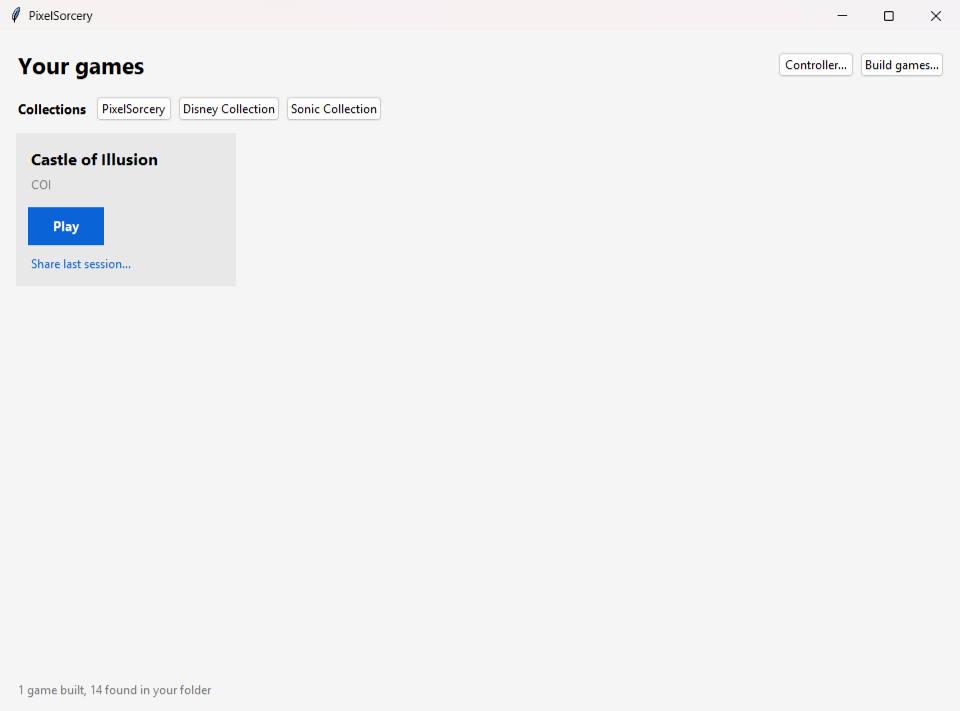
The same three screens on every computer: Build games… finds your dumps and compiles the ones you tick; Your games has a card per built game with Play, and Collections opens a shelf to go from game to game in fullscreen; Controller… maps your gamepad. Share last session… sends nothing until you have read and accepted what would be shared.
Checked against the original
Game coverage
Share of each game's code that has run in a replay verified against the original (1 November 2026). Reachable counts the code the game can actually run: functions that ran, plus everything their code calls or jumps to. All code also counts leftover routines nothing calls. Code that hasn't run yet still works: it falls back to the built-in 68000 interpreter, so lower coverage costs speed, not correctness.
| Game | Reachable code verified | All code | In the app |
|---|---|---|---|
| Castle of Illusion | 87.4% | 51.2% | yes |
| QuackShot (REV00) | 87.8% | 54.2% | yes |
| QuackShot (REV01) | 86.5% | 45.9% | yes |
| Sonic the Hedgehog 2 | 79.9% | 60.9% | yes |
| World of Illusion (USA) | 77.9% | 27.4% | yes |
| Sonic the Hedgehog | 76.6% | 59.3% | yes |
| World of Illusion (Europe) | 75.6% | 29.1% | yes |
| Knuckles in Sonic 2 | 72.5% | 52.5% | yes |
| Sonic 3 & Knuckles | 71.1% | 36.3% | yes |
| Sonic & Knuckles | 67.7% | 35.7% | yes |
| Sonic the Hedgehog 3 | 63.0% | 32.4% | yes |
| Knuckles in Sonic 1 (our own) | 53.4% | 40.7% | yes |
| Sonic CD (Mega CD) | runs native (the Mega CD too); coverage not measured yet | yes (needs your BIOS) | |
Native, no emulation
No game included
PixelSorcery ships no ROMs and no code or data made from them. Every game is built on the player's machine, from a dump of a cartridge they own. Free for non-commercial use (PolyForm Noncommercial).